
Tax & Payroll
Payday Super Has Started. Is Your Business Ready?
The Businesses Treating This as Someone Else’s Problem
Eighty percent of Australians didn’t know payday super was coming. Eighty-five percent had no idea when it would start. I saw that stat and it stuck with me, because if you employ even one person, this isn’t background noise. It already started, on 1 July 2026, and the businesses treating it as someone else’s problem are the ones I’m hearing from now.
I work with a lot of small businesses who employ one or two people, sometimes a small crew, and the reaction to payday super has mostly been the same: a vague awareness that something changed, and no real sense of what to actually check. So let’s fix that.
What Actually Changed
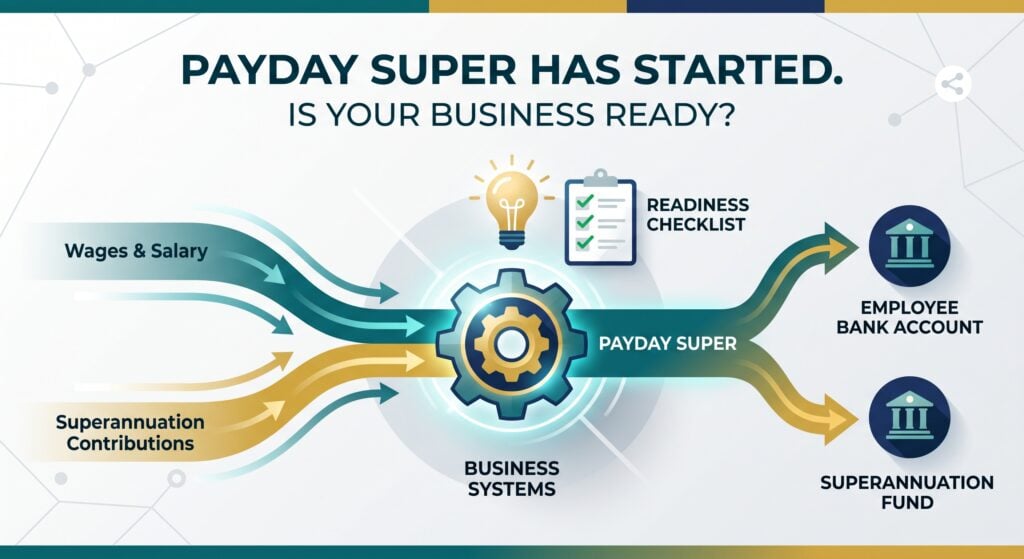
Until 30 June 2026, employers paid super guarantee contributions quarterly. You had until 28 days after each quarter ended to get it sorted, which gave most businesses a bit of breathing room if cash was tight one month. From 1 July 2026, that breathing room is gone. Super now has to go out on payday, alongside wages, and it generally needs to land in the employee’s fund within seven business days of that payday.
The rate itself hasn’t moved. It’s still 12 percent. What changed is the rhythm, and for a lot of small businesses, the rhythm is the part that actually costs money if you get it wrong.
Casual, Part-Time, Seasonal Staff — and the Subcontractors Most Businesses Miss
This isn’t just a full-time-employee rule. If you’ve got casual staff, seasonal workers, or people on part-time hours, payday super applies to their qualifying earnings as well, calculated the same way, on the same payday.
Superannuation legislation includes a category called ‘deemed employees’ — certain subcontractors who are treated as employees for super purposes, even when they’re not on your payroll and you’re paying them via invoice. If a contractor works wholly or principally for your business under a contract that is wholly or principally for their labour, they may be a deemed employee, and you may owe them super under the same payday rules.
This is the group we expect to cause the most compliance problems over the next 12 months, because they are invisible to most payroll systems. If you use contractors regularly — particularly in construction, trades, or professional services — it is worth getting a proper assessment of whether any of them qualify as deemed employees before the next pay run.
A lot of hospitality and retail businesses run heavier on casual staff than anywhere else, and this is exactly where I’ve seen the most confusion, because people assume the old quarterly habit still applies to anyone who isn’t a permanent full-time employee. It doesn’t.
Why the Timing Trips People Up
If your payroll software isn’t already set up to calculate and send super the moment wages go out, you’re relying on remembering it manually, every pay run, for every employee, forever. Miss it once and you’re already exposed to the superannuation guarantee charge. Getting the systems right through proper bookkeeping is genuinely the difference between this being a non-event and this being a recurring headache.
The Clearing House Problem Nobody Saw Coming
The ATO’s Small Business Superannuation Clearing House closed fully from 1 July 2026. If that was your system, you don’t have a system anymore, and you need one before your next pay run, not after it.
Most businesses in this position move to a payroll platform that handles it automatically. If you’re already on Xero, getting this set up properly is one of the more useful half hours you’ll spend this month. If you’re not on Xero yet, it’s worth asking whether now is the moment to switch.
What Happens If You Get It Wrong
The superannuation guarantee charge isn’t just the shortfall you owe. It’s the shortfall, plus interest that compounds daily, plus an administrative component, and repeat issues can mean penalties stacked on top. There’s a lot of moving parts here that most people don’t think about until it’s already gone wrong.
The one genuinely useful thing in the new rules is that the charge itself is tax deductible, which softens it slightly. It doesn’t make it a good use of your Tuesday.
It’s Not Just About Avoiding Penalties
There’s also a genuinely good reason this changed, beyond compliance. Employees now see their super land within days of being paid rather than waiting up to four months under the old quarterly system. For a young apprentice or a new hire, watching that balance move regularly is a small but real trust-builder, and for you as the employer, it’s honestly one less quarterly deadline sitting in the back of your mind.
What Good Compliance Actually Looks Like
It looks unremarkable, honestly. Super calculated automatically off each pay run. A payment method that gets the contribution into the fund in time to be recieved within seven business days, without you thinking about it. No manual step where a busy week means it slips through.
If you’re building this out properly for the first time, it’s worth treating it the same way you’d treat any other broken business process, and that’s genuinely where business coaching earns its keep, because half of getting this right is fixing the workflow, not just understanding the rule.
Three Things to Check This Week
- Check your payroll software. Is it already calculating super correctly on each pay run, or does it require a manual step?
- Check your payment timing. The contribution needs to land inside the fund within seven business days — not just leave your account. Those are not the same thing.
- Check the clearing house. If you were using the ATO’s Small Business Superannuation Clearing House, that decision has already been made for you. You need a replacement before your next pay run.
If you use contractors, check whether any of them may qualify as deemed employees under superannuation legislation. If they work wholly or principally for your business under a contract that is principally for their labour, you may owe them super under the same payday rules — even if they are invoicing you, not on your payroll. This is the most commonly overlooked compliance gap in the new rules.
If any of those feel shaky, it’s worth a proper look at your accounting and tax setup rather than guessing your way through the next quarter.
Want a straight answer on whether your business is compliant with payday super?
Not a guess — a proper look at your payroll setup, your contractor arrangements, and whether the systems are actually working.
Or you can start with our checklists and resources if you’d rather do a self-check first.

Frequently Asked Questions
Payday super started on 1 July 2026. From that date, employers are required to pay super guarantee contributions on payday alongside wages, with the contribution generally needing to land in the employee’s fund within seven business days. The old quarterly system no longer applies.
Yes. Payday super applies to all qualifying employees regardless of employment type — full-time, part-time, casual, and seasonal staff. It also applies to certain subcontractors who are classified as deemed employees under superannuation legislation, even if they are not part of your regular payroll system.
The ATO’s Small Business Superannuation Clearing House closed on 1 July 2026. If you were using it, you need a replacement system before your next pay run. Most businesses move to a payroll platform such as Xero that calculates and submits super automatically on each pay run.
If super is not paid on time, you may be liable for the superannuation guarantee charge — which includes the shortfall amount, interest that compounds daily, and an administrative component. Repeated failures can attract additional penalties. The charge is tax deductible, but it is not a good outcome.